Skip to content

Meet EUDR With Confidence. Build First-Mile Resilience From the Ground Up.

  • Treefera empowers companies to comply with EU Deforestation Regulation through defensible, plot-level data across all regulated commodities.
farm overlay

A New Regulatory Standard enforceable December 30th, 2025.

  • The EU Deforestation Regulation is here and compliance is not optional. For relevant commodities imported into the EU after December 30th 2025, EUDR demands.
icon tree
Deforestation-free and degradation-free sourcing
icon-4
Precise geolocation data
icon-2
Risk assessments and audit-ready due diligence with supporting evidence.
icon-3
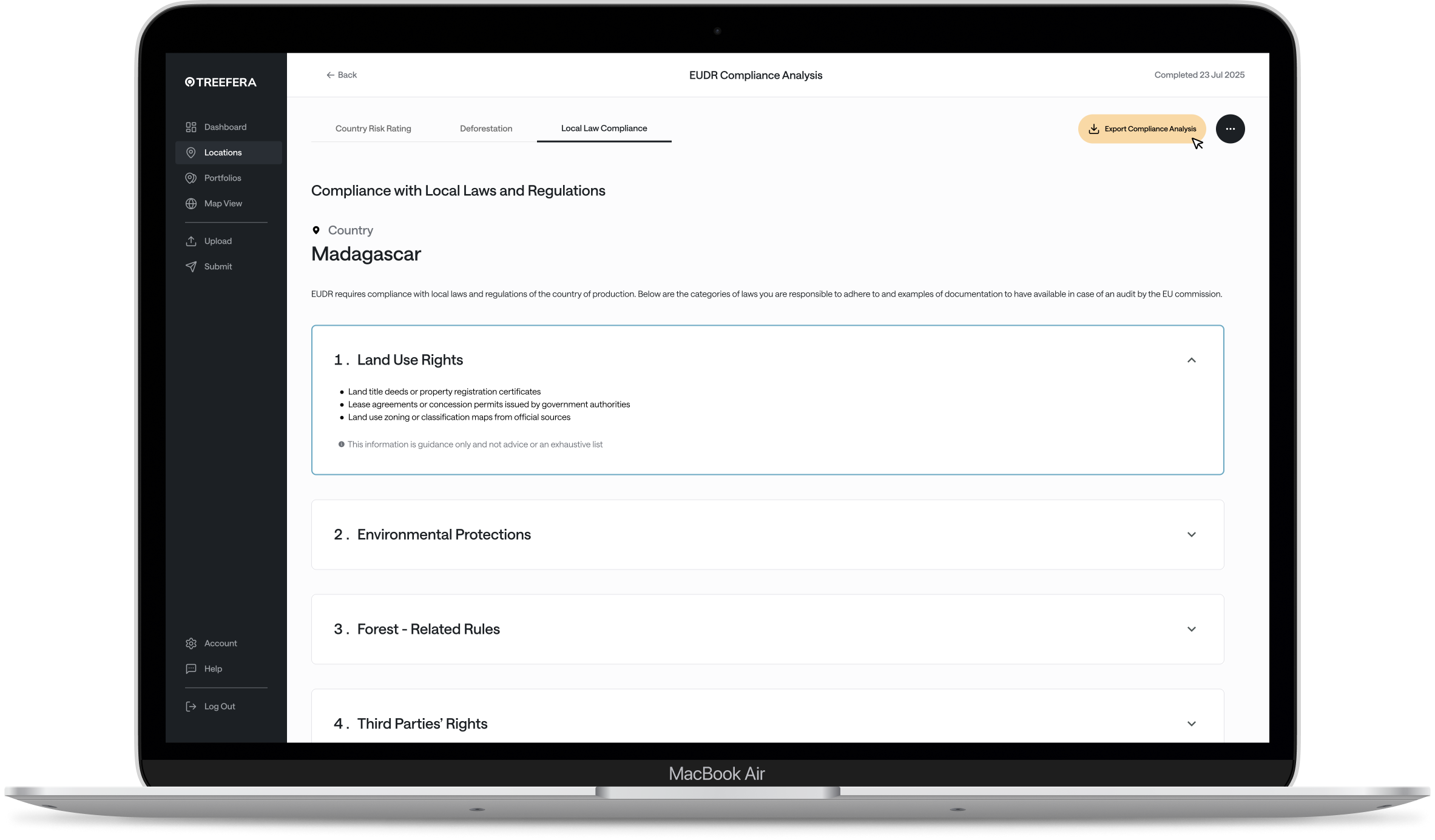
Local law compliance

Treefera provides the data and infrastructure to meet this requirement  - synthesizing AI, satellite imagery and ground-truth validation to deliver plot-level transparency across sourcing, risk and compliance.

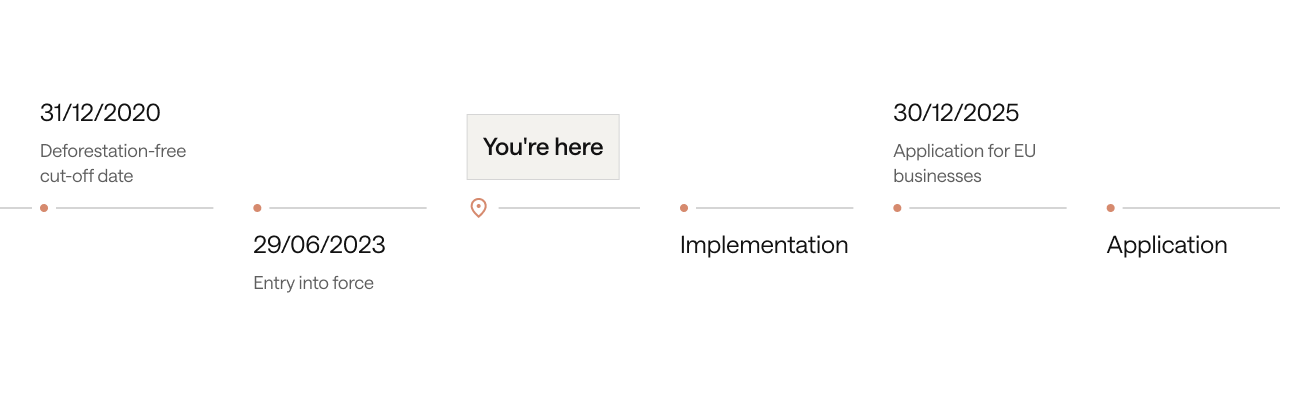
EUDR Timeline

Timeline progress-1

Are you EUDR ready?

Find out now.

Take our supply chain readiness quiz to find out if you’re affected – and what steps you need to take next.

  • Check if you are subject to EUDR
  • Understand your risk level and due diligence obligations based on your company status, commodities and sourcing location
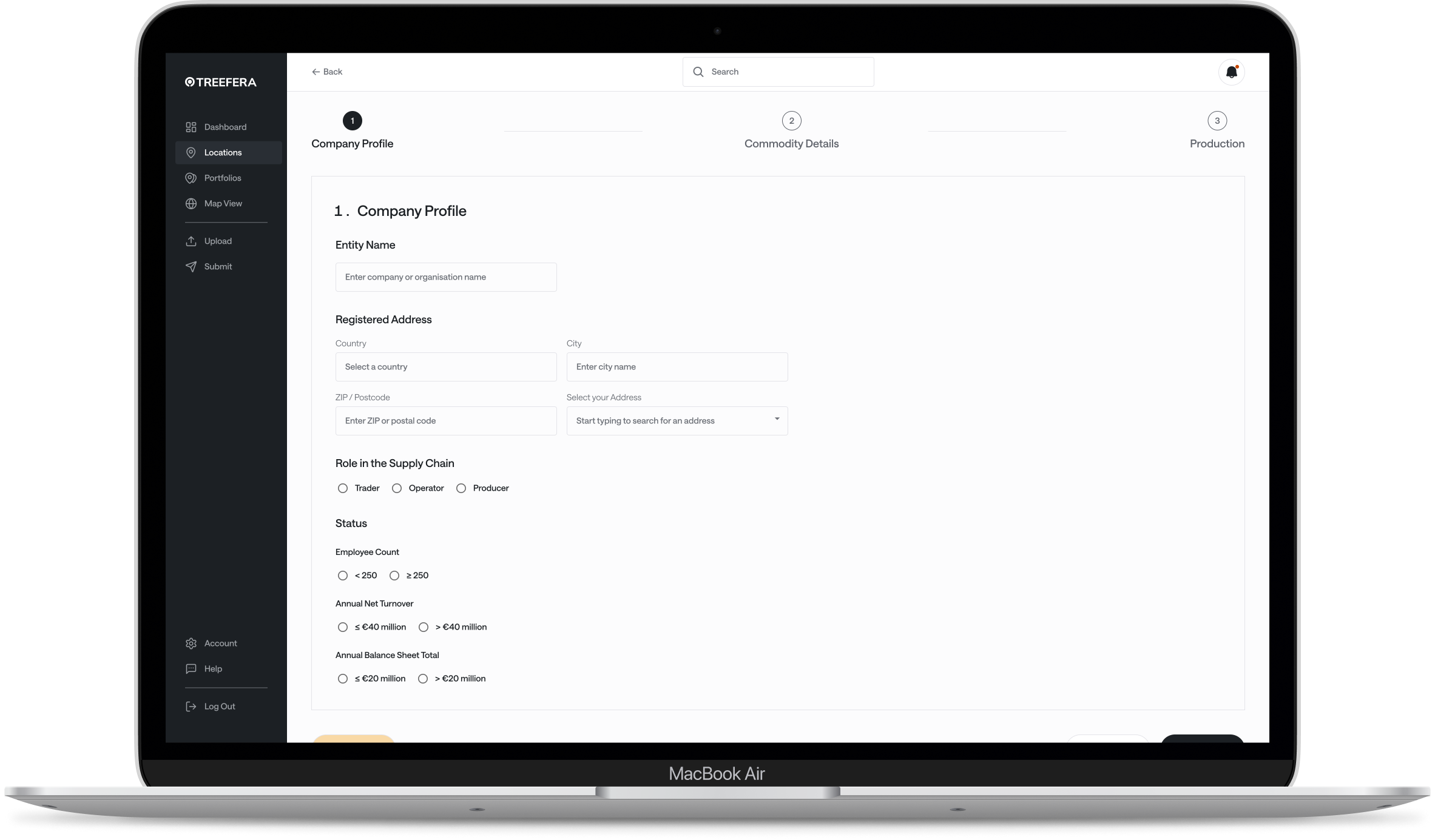
  • Identify what data you need to prepare
  • Get a tailored action plan for next steps


Compliance Starts
at the Source

Treefera delivers audit-ready, plot-level data to help you meet EUDR requirements and unlock resilience across your supply chain. Leverage Treefera’s AI-enabled data fabric to transform EUDR compliance into a strategic advantage, ensuring transparency and sustainability from the first mile.

Discover

What’s in scope?
Where’s the risk?

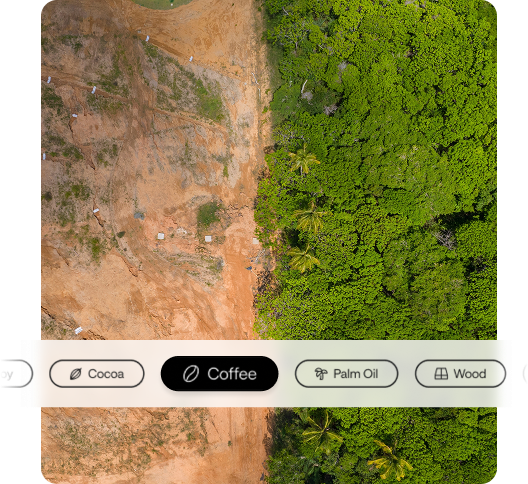
Map your commodities to the plot-level and classify land use and forest type conversion to build a complete picture of exposure aligned with EUDR definitions.
Discover

Analyse

Are your suppliers compliant?

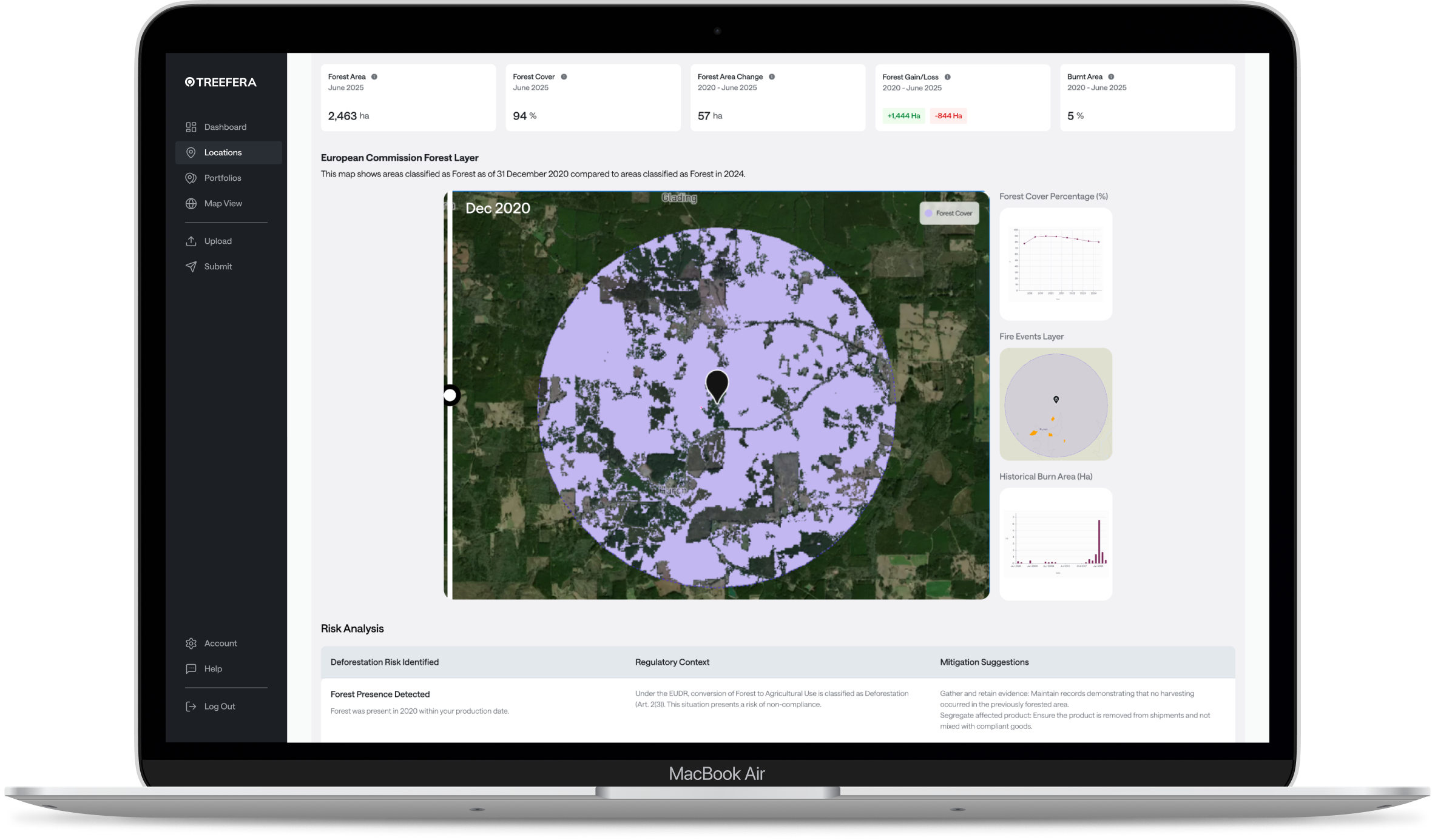
For all imports from 30 Dec 2025, evaluate each sourcing site for deforestation post-2020, land legality and jurisdictional risk. Treefera validates plot boundaries and classifies risk by analyzing satellite and historical data with Treefera AI, providing verified assessments of compliance with EUDR.
Analise

Monitor

What’s changing and what does it mean?
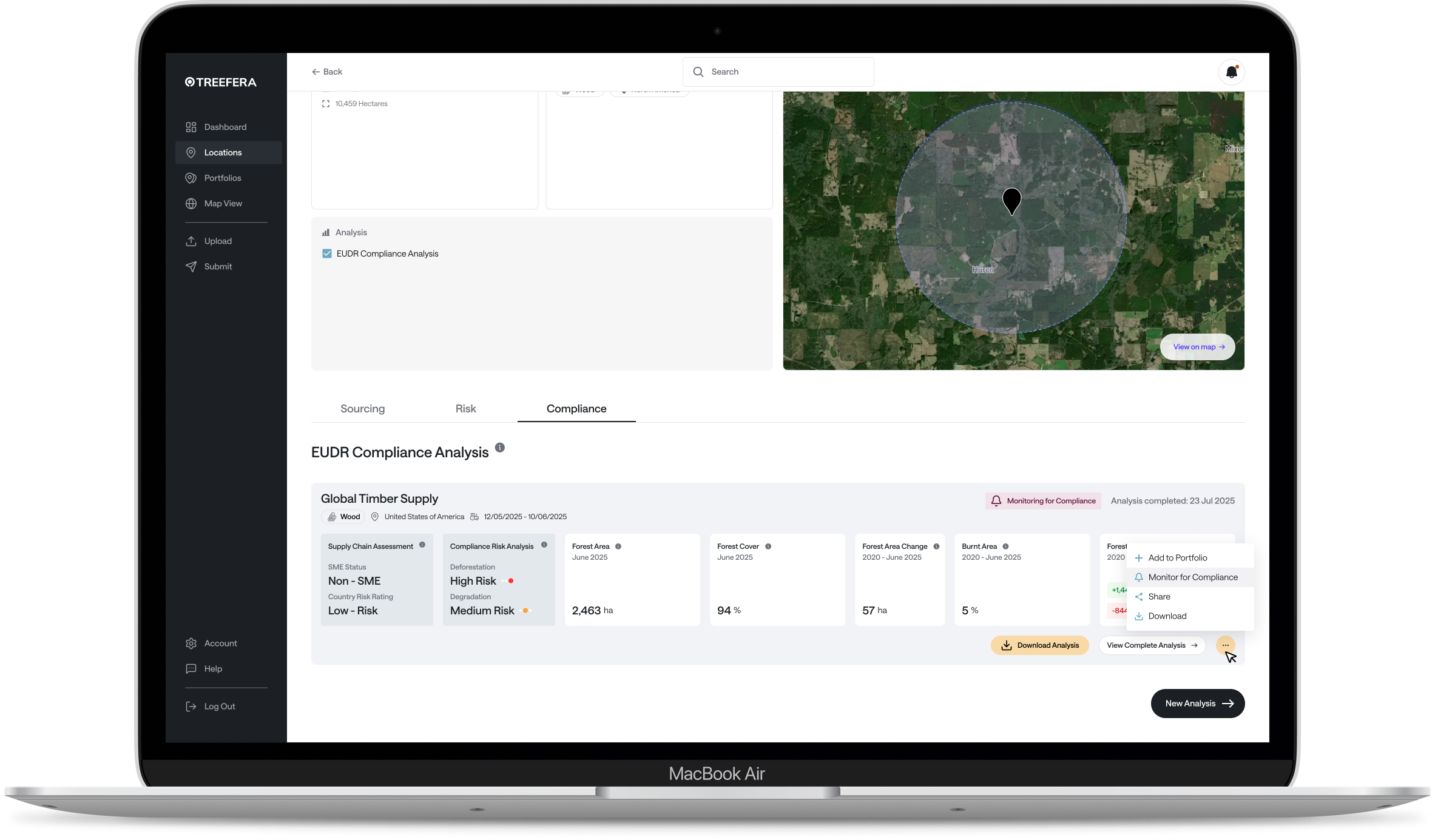
Track real-time changes in land use, legal risk or sourcing activity. Get automated alerts for ongoing monitoring on potential non-compliance exposure - so you can act before audit deadlines or supply disruptions hit.
Monitor

Act

How do I report and demonstrate compliance?
Treefera compiles the due diligence records, geolocation data and legality checks needed for EUDR reporting allowing our customers to submit traceable documentation that supports regulatory filings, ESG disclosures and internal policies.
Report

From Traceability to Trust: Turn Compliance into your Advantage

Meeting the requirements of the EU Deforestation Regulation (EUDR) demands more than policy alignment. It requires defensible, accurate and timely data on the origin and legality of commodities. If you’re looking to deepen your readiness, this guide offers clear direction grounded in legal expertise and informed by real-world use.

Understand EUDR.

Act with Confidence.


Card image

Plot-Level Proof: How to Achieve EUDR Compliance with Precision

Sogand Shaker-Grambas
As enforcement of the EUDR moves forward, the ability to demonstrate plot-level compliance is no longer optional. This blog unpacks how to achieve that.                                                                                                                                                              
Read more
Card image

From Blind Spots to Audit-Ready: Solving First-Mile Challenges with AI and Satellite Data

Adeline DeYoung
This blog post explores how Treefera uses satellite monitoring and AI to bring visibility to the first mile – enabling companies to detect and respond to risks early.
Read more
Card image

EUDR Compliance: Turning Regulation into Resilience

Sogand Shaker-Grambas

This blog dives into how Treefera helps organizations onboard new suppliers and assess local risk factors – enabling stronger partnerships across regions and value chains.  

Read more

FAQs

What is the EU Deforestation Regulation (EUDR)?

The EUDR is a new European Union regulation requiring companies to prove that certain commodities and products are not linked to deforestation or forest degradation, and produced in accordance with local laws. It applies to 'operators' and 'traders' placing goods like coffee, cocoa, cattle, soy, palm oil, wood, and rubber on the EU market – or exporting them from it.

When does the EUDR come into effect?

The regulation applies from 30 December 2025 for large companies with a 6 month grace period before penalties kick in, and 30 December 2026 for SMEs (ie a company which meets at least two of the following three criteria: up to 250 employees, €40m turnover, €20m balance sheet). Goods produced from 29 June 2023 onwards are in scope. Businesses must be ready to submit due diligence statements for any in-scope products and commodities placed on or exported from the EU market by these deadlines. 

Which products and commodities are covered under the EUDR?

The EUDR applies to seven key commodities:

Cattle
Cocoa
Coffee
Palm Oil 
Rubber
Soya
Wood
And their derived products (e.g., leather, chocolate, furniture, paper). The scope may be expanded by the European Commission.

What does ‘deforestation-free’ mean under the EUDR?

Under EUDR, “deforestation-free” means that the commodity or the derived product has not been produced on land where deforestation has occurred anytime after 31 December 2020, i.e. conversion of forest into agricultural land, regardless of whether the conversion was human-induced or not. For wood or wood-derived products, companies must also prove they are "degradation-free", i.e. no structural changes to a forest leading to a reduction in its quality and biodiversity – such as converting primary forest into plantation forest – have taken place. 

What are the traceability requirements for EUDR compliance?

To prove that no deforestation or forest degradation occurred, companies must trace back to all plots of land from which the product or commodity was produced, and provide geolocation data for these plots of land. This means polygon outlining full plot boundaries for most cases, or single-point coordinates for plots under 4 hectares. The exception is cattle, where single-point coordinates can be provided.

Do I need to monitor for ongoing deforestation or land-use change over time after the initial assessment?

Yes. Ongoing monitoring is necessary to maintain compliance after undertaking your initial due diligence and risk assessment / mitigation, as long as you continue to source from the same plot. Deforestation activity near the relevant plot or significant events such as fires can affect the ‘deforestation-free’ status of that plot after the initial assessment, so it is important to proactively monitor this before it becomes a non-compliance issue.

What is due diligence statement (DDS) under EUDR?

A DDS is a formal declaration submitted via the EU’s TRACES system, affirming that the products are deforestation-free, legally sourced and compliance with all relevant local laws and regulations. It must contain verifiable data on product information and quantities, geolocation data of all production plots, contact details of suppliers and declaration of compliance with EUDR. All DDS and any supplementary records (e.g. risk assessment or mitigation information supporting the DDS) must be retained for a minimum of 5 years and provided to regulatory authorities on request.

What happens if I don’t comply with EUDR requirements?

Penalties for non-compliance will vary depending on the Member State enforcing it, but it can include confiscation of products, being temporarily blocked from dealing in the EU market, reputational damage, and maximum fines of at least 4% of annual EU turnover.

How can Treefera help with EUDR compliance?

Treefera provides plot-level geolocation data, land-use verification, and real-time deforestation monitoring – all in one platform. Our AI-enabled data fabric turns fragmented supply chain data into audit-ready, defensible insights aligned to EUDR standards.

Can Treefera support multi-origin or smallholder supply chains?

Yes. Our platform is designed to handle complex supply chain environments involving composite products and smallholders, using scalable geospatial tools and adaptive AI to close traceability gaps.

See Treefera in Action